
MUSÉE D’ORSAY ARCHITECTURE
About Musée d’Orsay
The Musée d’Orsay was originally designed as the Gare d’Orsay, a railway station constructed on the site of the Palais d’Orsay, located on the Left bank of the Seine River and across from the Tuileries Gardens. The building featured a stunning Beaux-Arts exterior and modern interior elements like metal construction, elevators, and electric railway tracks.

The Orsay Station: A Beaux-Arts masterpiece
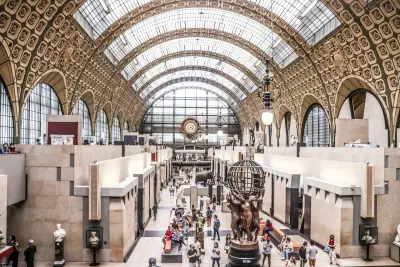
The Gare d’Orsay railway station was built in the intricate Beaux-Arts style, which blends classical design with modern materials like steel and glass to reflect the technological progress of the late 19th century. It was also inspired by contemporary American railway stations. The building has a steel frame, large glass windows, a barrel-vaulted hall, and a white limestone exterior to blend with the surrounding area and the Louvre.
Seven arched doors lead into the main hall, which faces the center. The roof leans toward the Louvre, and the facade is decorated with sculptures of lion heads, oak branches, and laurel leaves. Architect Victor Laloux designed the station with modern features like luggage ramps, elevators, and a hotel.

From station to museum
Despite its modern technological design, the Gare d’Orsay closed in 1939 because its platforms could not accommodate longer trains. It continued serving some suburban rail services until 1973. In the 1970s, plans to convert the station into a museum were approved in 1977 under President Giscard d’Estaing. The decision to transform the Gare d’Orsay into a museum came at a time when several national art collections needed more space. The National Museum of Modern Art moved to the Pompidou Centre, leaving behind artworks, while the Jeu de Paume and the Louvre were overcrowded. The Musée d’Orsay took works from these institutions and expanded its collection to include photography, decorative arts, and architecture. When it opened in December 1986, the museum had an impressive collection.

Preserving historical features
In the 1980s, with government funding, the ACT Architecture group restored the Gare d’Orsay. Architects Pierre Colboc, Renaud Bardon, and Jean-Paul Philippon added 20,000 square meters of exhibition space. Italian architect Gae Aulenti redesigned the interior, introducing key features like the two towers at the end of the central hall. The design preserved the original architecture while adapting it for the museum, emphasizing the grand hall as the main pathway. Aulenti worked with Jean-Baptiste and Richard Peduzzi on the architectural and scenographic design. The project balanced the preservation of the station’s neoclassical features with the needs of a modern museum. Elements like the central train hall, glass roof, steel beams, and large clock were kept, while the ceiling rosettes were restored and modified to include air-conditioning and soundproofing. This combination of history and innovation made the museum functional while preserving its historical charm.

Interior design: blending old and new
Musée d’Orsay architecture focuses on preserving the building’s history while making it a functional space for art. It combines 19th- and the early 20th-century architecture with modern museum design, creating a welcoming and inspiring environment for both artwork and visitors. The interior design was a team effort of a group of architects and designers whose goal was to highlight the building’s history while creating a functional space for art.
The iconic clocks
The building features two clocks-one facing the Seine and the Louvre and the other facing the Tuileries Garden. The clock facing the Louvre is particularly iconic, measuring 24 feet (7.3 meters) in diameter with a glass center, allowing visitors to enjoy a stunning view from the museum’s top floor.
Visit the Orsay Museum with our exclusive ticket offer!

Skip-the-line
Orsay Museum Ticket
Skip the crowds and enjoy direct access to the Orsay Museum to explore its masterpieces at your own pace. Discover the world’s largest permanent collection of Impressionist and Post-Impressionist paintings, including famous artists like Van Gogh, Degas, Renoir, Monet, and Cézanne. Walk through the beautifully preserved former Gare d'Orsay railway station and view the impressive collection of sculptures, decorative arts, and photography. Explore the art museum's permanent display and temporary exhibitions for a memorable Parisian art journey.

Space planning for the museum’s collections
The interior layout was designed to show 19th and early 20th-century art, including works by the Impressionists, Post-Impressionists, Realists, and Symbolists. Aulenti’s design spread galleries across three levels around an atrium under the iconic iron-and-glass barrel vault. The ground floor, once a train platform, was divided by stone structures to make space for sculptures and galleries for paintings and decorative arts. The central hall became the grand entrance, maintaining its open space for a dramatic first impression and adapting it for large sculptures and installations. The upper floors were organized into galleries by themes, with large windows and lighting to highlight the artwork. Escalators and staircases connected all museum levels for easy access.
The arrangements of the exhibits
One of the key innovations of the Orsay Museum architecture was its display of various art forms from 1848 to 1914, including painting, sculpture, architecture, decorative arts, and photography, all shown together to provide a complete view of the era’s artistic achievements. The exhibits were organized across three levels, grouped by themes and styles. The Impressionist paintings are displayed on the fifth floor, in a gallery that spans the entire length of the fifth floor along the Seine side of the museum. The museum also holds architectural drawings from the original design of the station by Victor Laloux and its transformation into a museum.

Light and ambiance
The interior design used natural light to make the museum experience better for the visitors. The glass roof in the central hall allowed daylight to fill the space, while softer lighting was used in the galleries.
Lighting was carefully selected to complement the natural light. Track lights focused on the artwork, while diffused lighting created a gentle atmosphere. In the evening, the museum’s lighting made the building glow, highlighting the colours on the walls and the subtle shades in the paintings.
Materials and colours
The interior design of the Musée d’Orsay combined historical materials with modern finishes to balance the building’s heritage and the needs of a modern museum. Metal, wood, and stone preserved the station’s original aesthetic, while steel beams and columns were kept to highlight the building’s industrial character. The color scheme was simple and elegant, with neutral tones like white, beige, and wood. These colors created a simple backdrop that made the artwork stand out without overwhelming the space.

Furnishings and interior decor
In line with the concept of creating a modern, functional space while keeping the museum’s historic charm, the furniture was minimalist and practical and designed to blend in. Visitors’ comfort was a priority, with benches and seating placed throughout the galleries.
Museum facilities and visitor experience
The museum’s layout focused on creating an easy and smooth visitor experience with clear signage and a simple layout. Several cafés and rest areas were carefully placed to offer relaxation without disrupting the galleries. The shop and administrative areas were located on lower levels to ensure they did not interfere with the art experience.

Further renovations
Between 2009 and 2011, the Musée d’Orsay renovated parts of its interior, including the Impressionist galleries and café, to improve visitor flow and security. Under the direction of Guy Cogeval, the museum also carried out a major renovation of the Impressionist Post-Impressionist galleries and the decorative arts floors in the Amont Pavilion. In 2013, the rooms beside the central aisle were renovated, and the Luxembourg Rooms were renamed, honoring the Musée du Luxembourg, where the collection initially started.
Musée d’Orsay today
Every year, millions of visitors who enter the Musée d’Orsay are welcomed by the beautiful decor of this former station that was almost destroyed. The museum stands as a testament to the preservation of history and the transformation of a landmark station into a world-class museum.
Want to explore how the Orsay station became a world-class museum?

Avoid a big crowd
Orsay Museum Small-Group Tour
Join a small group tour of the Musée d'Orsay for an intimate, guided experience of its world-renowned art collection. Explore masterpieces by Monet, Van Gogh, Degas, and Renoir while your expert guide provides interesting insights into the art and the artists. Learn about the history of this unique museum, which was once a railway station. Enjoy a personalized, engaging tour in a smaller group setting, ensuring a more relaxed and informative visit.

Customize the tour's itinerary
Orsay Museum Private Tour
Experience the Musée d'Orsay like a VIP with a private tour, offering an exclusive and personalized journey through one of Paris' most iconic museums. Enjoy priority access and a more intimate visit to the museum. Your expert guide will lead you through Monet, Van Gogh, Degas, and Renoir masterpieces, providing in-depth insights into the art and history. Explore at your own pace, with special attention to your interests. Optional hotel pickup is available for a comfortable and unforgettable art experience.